
My name is Ricky. I’ve been a guitarist for over two decades. Music has always been the center of how I experience and understand the world. Long before I ever thought about building pedals, I was learning how sound responds to touch, dynamics, and intention. That relationship with the instrument continues to shape everything I create.
Alongside music, I grew up with a natural curiosity for electronics. Encouraged early on by my father, I explored circuits, components, and signal paths for years. I learned how subtle changes dramatically alter behavior and feel. Over time, that curiosity became a way of thinking, one rooted in patience, observation, and respect for process.
After finishing law school, I dedicated myself to work in the broader world of the financial and private markets. While seemingly far removed from music, that experience sharpened my appreciation for structure, clarity, and thoughtful decision-making. It taught me to value systems that are built with care and intention. These lessons quietly carried over into my creative work.
Around 2024, those paths naturally converged. Years of playing guitar led me to begin repairing guitar pedals. Experimenting with electronics and thinking analytically enabled me to modify and eventually design them. I approach pedals not as trends or statements. I see them as instruments in their own right. Their character is shaped by how they interact with the player, the guitar, and the amplifier.

ROMA Devices is the result of that convergence. It is a space where music, curiosity, and craft meet. Each pedal is designed to be expressive, responsive, and purposeful, built to reward nuance and feel rather than excess. Everything I make is guided by a simple idea. When a circuit is designed with care, it disappears. This leaves only the player and the sound.
The guiding principle behind ROMA is control. I design circuits to be expressive and responsive, but never passive. I want pedals that react decisively to touch, volume, and attack, and that can push back when played hard. Each design is meant to feel alive under the fingers. It should interact naturally with the guitar and amplifier. It should not just sit politely in the signal chain.
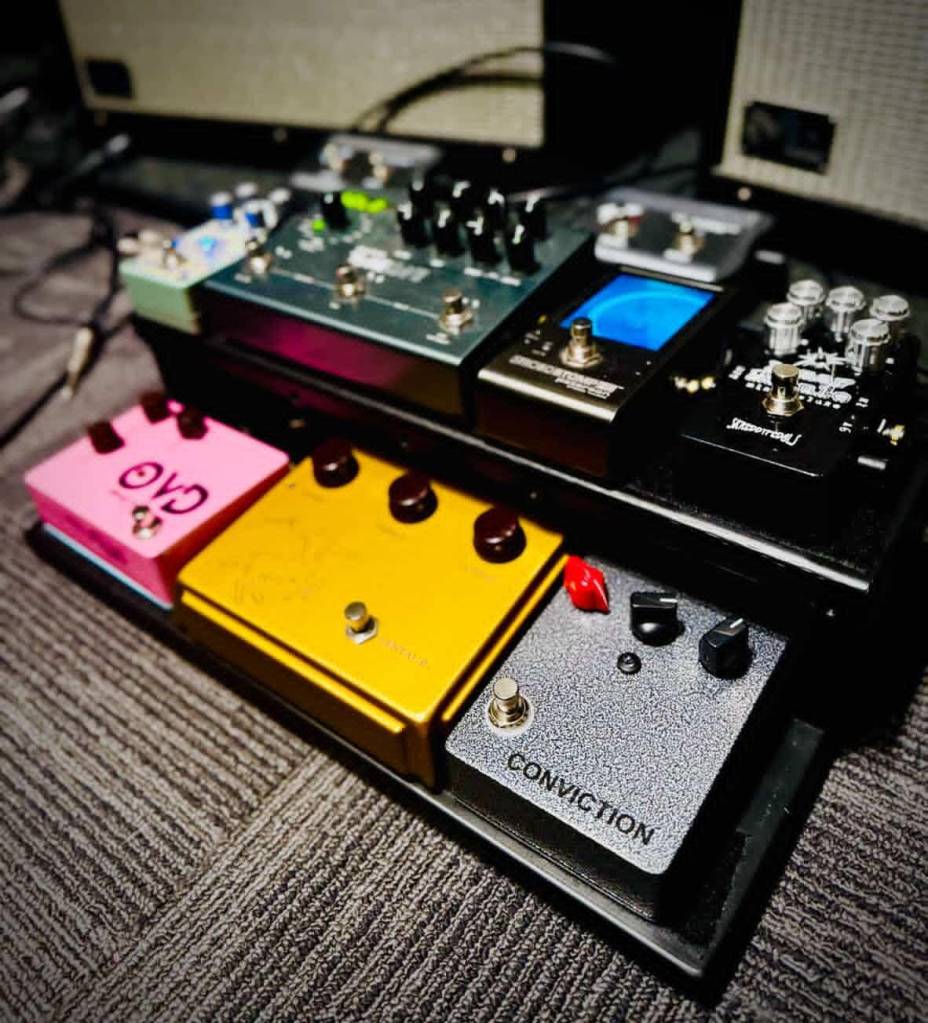
Conviction was the first clear expression of that philosophy.
It began as a personal exploration of overdrive that leaned deliberately toward the aggressive side. I wasn’t interested in building a polite or transparent drive. I wanted something that could hit an amp hard, compress, bite, and then break apart when pushed further. Early versions were built, torn down, and rebuilt repeatedly. Most decisions were guided by how the circuit behaved at higher gain levels. The measurements on paper were less important.
Conviction is designed to move from drive into tension. It can be forceful, raw, and expressive, but it remains deliberate rather than chaotic. Nothing in the circuit exists by accident, and nothing was added simply to soften its edges.
Conviction represents the foundation of ROMA Devices. It reflects my belief that interesting sounds exist at the edge of control. This is where aggression, feel, and intention meet.
 ROMA
ROMA 